
26 is Not My Name - A Statue Speaks of Theft, Return, and the Search for Home
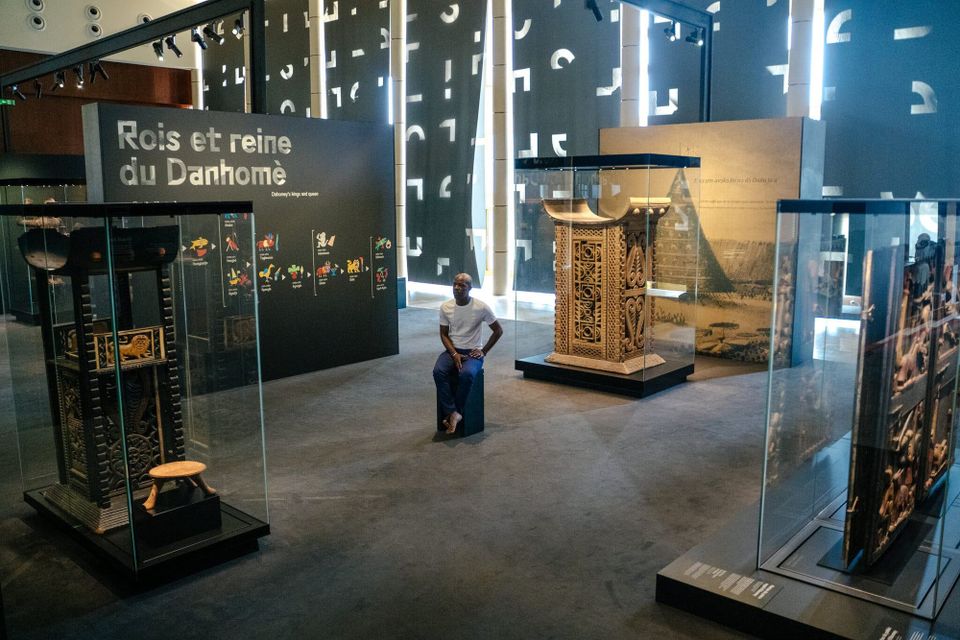
I remember the warmth first. It was not like the heat of fire that hardened my clay, but more like the heat of breath and bodies, forming my body, moving around me, the heat of song embedding me with powers of intention to my people. A great people. I was born where meaning mattered more than the trivialities of wealth and conquering to keep up with the Joneses. I stood in the Kingdom of Dahomey as a physical representation of King Ghezo. I was not a decoration to make the street look pretty. I was the presence of my people's resilience, glory, and long history. I held their memory in my tall, upright posture. I also held a warning visible through my stance. I denoted the strength of refusal, of defiance. I was shaped to remind our people who they were and what they would not become, shaped by thousands of years of past magnificence and thousands more in the future. Before the foreign ships, before the uniformed pirates, before the estranged languages forced into mouths that already knew how to speak to the land and people, I existed to anchor time.
Then came a savage violence that called itself 'order.'
Theft
On Thursday, November 17, 1892, French colonial forces invaded the Kingdom of Dahomey. They and their neighbors wanted all of the continent for its wealth and resources. What followed was systematic plunder and looting. They did not seek to learn the languages, the culture, nor eat the local food. They weren't tourists. No evidence suggested a search for knowledge that could help improve human lives everywhere. They showed no interest in the medicines, architecture, or respect for way of life. Even today, few Europeans bother to learn African languages, while Africans often have their languages borrowed as official, plus many local languages. They arrived to extract. Resources, people, culture, music, lives, anything that can be monetized with the right imagination. To take. Over 7,000 artifacts were looted from the royal palaces of Abomey, from sacred spaces, from places where objects bore the importance and respect of governance and spiritual authority. It was like stealing the Virgin Mary statues from Catholic churches. I was among them. I was catalogued, numbered, and shipped across an ocean to Paris, where I would spend the next 130 years behind glass at the Musée du Quai Branly. They called me Statue 26, or number 26. Clearly, that's not my name.
The soldiers who wrapped me in sackcloth and crated me for transport did not ask why I stood where I stood. They did not ask why my shape mattered or what ceremonies had given me purpose. Few wondered what would be erased from my people with my removal. None expressed interest in who would miss my absence. They only knew that removing me was an act of dominance. Take. Seemingly, a strategy to rule a people, you sever their relationship to their own symbols. You scatter their memory and connections across oceans and then accuse them of having none, being a dark and desolate continent. Teach the descendants that the made-up history is the real one. No history and no memory. I was taken because I represented defiance. Because I was not ornamental. Not a symbol of excess and show-off-ness. You see, my presence contradicted the false story that Africa had no history worth preserving. Take, then lie through the teeth to hide the theft.
Documentary and Debate
In 2024, director Mati Diop released Dahomey, a documentary that won the Golden Bear at the Berlin Film Festival. The film follows the journey of twenty-six returned artifacts, myself included, from Paris back to Benin in November 2021. Twenty-six out of 7,000. The film does not celebrate this return as a triumph because it's a tiny portion of what was taken, less than 1%. It questions it. At the University of Abomey-Calavi, students debate what this gesture means. Some call it an insult as they hold so many more artifacts, wealth resources, culture, and many people stolen, and even today, the plunder continues through unbalanced trade policies, debt encouragement, bullying, domination, and even military invasion in some states. Others see it as a beginning. Better than nothing, right!? One young woman optimistically said the future feels navigable again. Another asks why thankfulness is expected when theft is only being restored to a negligible extent. There was passion in these future leaders' voices, and they want it all back and for the present looting to stop. They want the taking to stop.
You see, these are the conversations that matter. Not the ceremonies with politicians with their handshakes, careful not to offend Europe in their speeches, and photographers making sure they look good in the light. Suck it in! I loved the raw questioning of young people who understand that restitution without full accounting is only theatre. No French representative publicly pledged the return of everything stolen and apologized for their pirated ways. No pledge, no action. Just a tiny, micro, minuscule token. They know! They know that 26 objects cannot restore what was dismantled. They know that their education still centers on Europe, that their languages have been demoted, that their histories are taught as footnotes to colonial narratives. The students felt frustrated that even the debate was in French, not their native tongues. This made them, obviously, angry.
They Took More Than Objects
When I was removed from Dahomey, more than clay left the kingdom. The theft disrupted our knowledge systems that were around for thousands of generations. Children grew up without the visual grammar that had oriented their understanding of power, lineage, and accountability. Kings in Dahomey were not absolute rulers. They answered to councils. They were bound by ritual and expectation. They were not extractors. My presence, along with the thrones of King Glele and King Béhanzin, the royal scepters, the ceremonial doors carved with leopards and warriors, reminded everyone that authority was borrowed from the ancestors and could be withdrawn. All of this has to be relearned by the people.


Europeans saw stuff/things to gaze at. They believed these were quaint or exotic symbols that were evidence of their superior civilizing and violent mission, proof that they had subdued a kingdom they barely understood. What they did not see, or chose not to see, was that our absence made their ideological work easier. Without us, children could be taught that greatness arrived with colonization. Without us, resilience could be romanticized instead of respected. Without us, the structures that governed Dahomey for centuries could be erased from memory and replaced with imported models of governance that served foreign interests, creating puppet leadership.
Coming Home to a Changed Land
When I returned to Benin, the air and land recognized me. The buildings less so, nor did I recognize them. Over 200,000 people came to see us at the presidential palace in the months after our return. What a tribute! One woman cried for fifteen minutes when she saw me, the statue of her king. She was mourning about how her own viewing and recognition were delayed by foreign-induced violence. But the landscape had changed. Borders drawn by alien pens had cut through the memory of my people and the land. French, a foreign language, remains the language of instruction in schools. Histories are still compressed, still filtered through European frameworks. Teachers talk of vague things taken by the French soldiers. Students thought these were trinkets until now. This is the second theft. Taking the objects led to the taking of the people's narrative authority to tell their own stories.
Longing of the Diaspora
I speak now not only for myself but for those who search for their past generations. Among them is a man from Antigua and Barbuda, a descendant of the captured, who does not know which kingdom his ancestors came from. He does not know if they spoke Fon or Yoruba, or Igbo. He does not know if they were builders, farmers, traders, or warriors, nor does he know what governance structures shaped their thinking or what architecture framed their understanding of home and economy. He wonders which tribes are most likely to cooperate, and which ones tend to fight or compete. He senses a huge hole in his knowledge of his ancestors. But he only knows that something was taken that cannot be named because it was never recorded. He learned history from books written by Englishmen. His A-levels teachers were adamant that he should learn to critique what he read. Others in O-levels only taught him to reproduce the books' contents to do well in school.
He searches for a DNA test that might tell him where his people originated, but the options are limited and compromised. Many companies sell genetic data for profit, turning ancestry into a commodity. The tests themselves often lack comprehensive databases for African populations, offering vague regional estimates instead of specific connections. He wants more than percentages. He wants to know the names of rivers his ancestors bathed in. He wants to know what foods they cooked, their recipes, how they built their homes, and how they governed themselves before being told they were property for someone to exploit to keep up with the Joneses. He wants this knowledge for himself and his children, as well as for his extended family, for the younger generation who deserve to know they come from people who built kingdoms, organized trade, and created beauty without needing permission or having it destroyed.
This is why he travels. He plans to go to places where colonization did not completely erase indigenous knowledge. He is a foodie and loves to taste foods that might mirror what his ancestors ate. He wonders if his palate can love the food or does he already. He listens to languages that might carry sounds his great-great-grandmothers spoke. He observes governance structures and economic systems that exist inside and outside European models to compare. He is searching for fragments, for home, for anything that might help him piece together an identity that was deliberately shattered for a market to sell sugar for sweetening tea and cotton for fancy clothes. He knows he may never find his specific origin point. He knows that enslavement was designed to destroy exactly this kind of continuity. But he searches anyway because the alternative is accepting erasure, and he is not into that!
He is not alone. Across the Caribbean and the Americas, everywhere, descendants of enslaved people, or people who suffered genocide, are searching for what was taken. They are learning languages. They are studying pre-colonial African and Indigenous history. They are traveling to the continent, to origin places, standing in front of doorways their ancestors might have walked through, meeting people who look like family, crying in museums, building museums, just like this man and his friends, to tell an authentic story, asking questions that have never been answered. They are opposing the same forces that took me from Dahomey: the insistence that the history of the second-largest continent, the cradle of mankind, paradoxically, begins with European contact, that knowledge requires validation from foreign institutions, and that home is wherever survival happened (Americas) rather than where belonging was rooted.
I Wonder What Full Restitution Would Look Like
Returning 26 artifacts is like an arsonist who stole from you, burns your home and family, then years later, his descendant gives your great-grandchild one of the coins he took before setting the blaze, then has a press conference to discuss how kind their family is. It is not restitution. It is a travesty. Full restitution would mean returning the remaining 6,974+ objects. It would mean funding educational reforms that center on pre-colonial African knowledge systems alongside contemporary curricula. It would mean supporting research into indigenous governance models, agricultural practices, architectural traditions, and economic structures that functioned before and despite colonization. It would mean creating accessible, ethical genetic databases that help descendants of the enslaved trace their origins without surrendering their privacy to corporations. It would mean trade that pays a reasonable price for the region's exports, which allows them to develop and move up the production value chain - real, respectful trade instead of pitiful aid.
Full restitution would mean dismantling the intellectual hierarchies that still position the global north as the standard against which all other cultures are measured. It would mean acknowledging and teaching that what was called discovery was, in fact, invasion, what was called preservation was, in fact, hoarding, and what was called education was, in fact, erasure. It would mean sitting with the uncomfortable fact that the foundations of many museums of the global north are built on organized theft masquerading as archeology, and that returning fragments while keeping the majority is not reconciliation. It's still theft!
I Am Not Finished
I am finally home, but my sisters and brothers are still scattered in basements, museums, and private collectors' homes, as if we were exotic souvenirs. Museums charge admission to see what was stolen. Taken. The young people of the future, the survivors, debate. Can we have the bodies back? Millions are searching for the same thing I represent: proof that they come from somewhere specific, somewhere with thousands of years of structure, love, beauty, and meaning, somewhere that existed fully before it was interrupted.
Look, I was never #26. I was never a souvenir or a trophy. I was always a witness. And I am still watching. Everyone is watching! Be on the right side of real history.
Sources
- Brown, Kate. "26 Royal Objects Looted From Benin by French Soldiers Are Going On View in Paris—Briefly—Before Being Returned" Artnet, October 25, 2021. https://news.artnet.com/art-world/quai-branly-benin-restitution-2025098
- Diop, Mati, director. Dahomey. 2024. IMDB
- Hicks, Dan. The Brutish Museums: The Benin Bronzes, Colonial Violence and Cultural Restitution. Pluto Press, 2020.
- Jones, Mayeni. "Benin Bronzes: 'My great-grandfather sculpted the looted treasures'" BBC News, 2021. BBC
- Sarr, Felwine, and Bénédicte Savoy. The Restitution of African Cultural Heritage: Toward a New Relational Ethics. 2018. https://www.unimuseum.uni-tuebingen.de/fileadmin/content/05_Forschung_Lehre/Provenienz/sarr_savoy_en.pdf
- Tate, Agnes. "Should Museums Return Their Stolen Artefacts?" University of Nothingham, 2024. https://www.hercampus.com/school/nottingham/should-museums-return-their-stolen-artefacts/
- "The Kingdom of Dahomey." UNESCO World Heritage Centre. https://whc.unesco.org/en/list/323
- "University Students Debate Return of Royal Treasures." The Guardian, November 2021. https://www.theguardian.com/world/2021/nov/17/benin-students-debate-return-french-looted-treasures


Member discussion